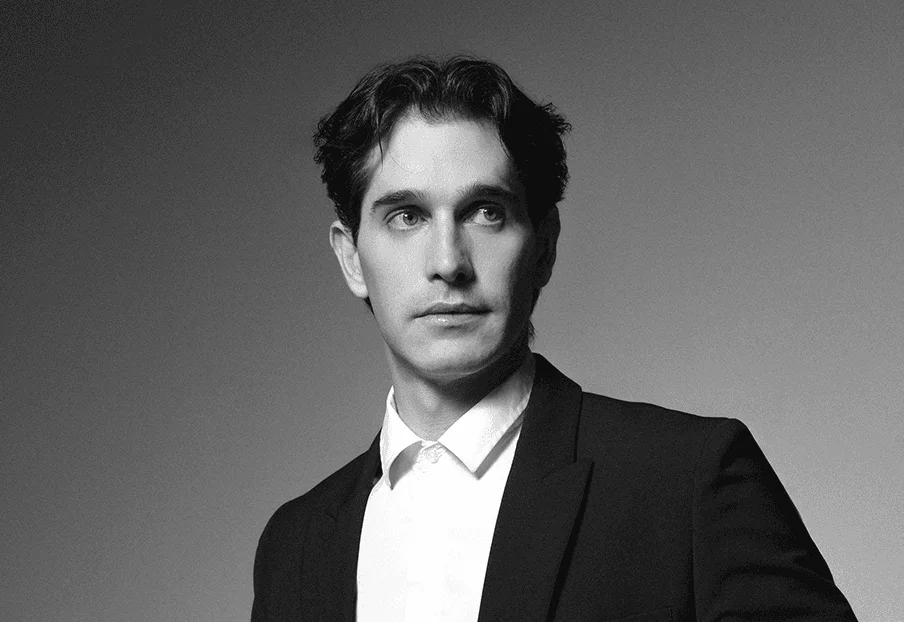
Victor Nouman, Partner and Architect
Victor Nouman is Partner and Architect at Studio By Three, a boutique interior design firm based in Al Quoz, Dubai. His work centres on hospitality and creative environments, and on a question he has pursued throughout his career: the relationship between architecture, interiors and storytelling. For Victor, a restaurant, café or hotel is not a shell to be decorated but a narrative to be built — the plan, the materials and the light all carry the story of the place. That approach runs through Studio By Three's hospitality portfolio across Dubai and Abu Dhabi, including the restaurants Mamafri Mamsha and Brunch Morsel, the cafés Let's Café and Osk Croissanterie, and the Momentum watch store in Dubai.
The interview
How would you describe your design philosophy?
We design bespoke spaces that blend contemporaneity, individuality and sophistication. Those three words are a test we apply to our own work. If a space is contemporary but could belong to anyone, it has failed. If it is individual but already dated, it has failed. The aim is an environment that is original and remains so.
Your background is in hospitality. What drew you to it?
Hospitality is the most demanding and the most rewarding brief an architect can take. A restaurant or café has to work hard — operationally, commercially — and at the same time it has to make people feel something within seconds of walking in. Very few building types ask for both at once. That tension is where I like to work.
You often speak about the relationship between architecture, interiors and storytelling. What do you mean by that?
That a space tells a story whether you intend it or not — the only question is whether the story is coherent. Architecture sets the plot: the volumes, the sequence, the thresholds. Interiors carry the detail: what you touch, where you sit, how the light falls at different hours. When the two are designed together, the guest reads one story without ever being told it. At Mamafri Mamsha in Abu Dhabi, for example, we treated the restaurant as an Asiatic-inspired pavilion by the ocean — architecture within architecture, with tiered wooden floors shaping how guests gather. The structure itself is the narrative.
What makes a strong hospitality concept?
One idea, carried through without compromise. A strong concept survives contact with the operational brief — the kitchen, the covers, the turnaround times — and comes out clearer, not diluted.
Do you have a favourite material or detail you return to?
I am drawn to materials that age with dignity, because hospitality spaces are lived in hard. A floor that improves with wear, a surface that records the life of the room — those are the details guests feel without naming.
How do you see Dubai’s design scene right now?
It is one of the most active hospitality markets in the world. Dubai welcomed 19.59 million international overnight visitors in 2025, a third consecutive record year according to the Department of Economy and Tourism, and the Michelin Guide Dubai 2025 awarded its first three-star restaurants — a signal of how far the F&B scene has come. Alongside that, the design conversation is shifting towards emotional resonance and hyper-localisation rather than pure spectacle. Owners increasingly want spaces with a genuine point of view, and that is precisely the work we like to do.
What advice would you give an owner starting a restaurant or café project?
Define the story before the style. Know what a guest should feel in the first ten seconds and what they should remember a week later; the design follows from that. Involve your design team at the same moment you involve your operator — the strongest hospitality spaces are the ones where narrative and operation were planned together, from the first sketch.
Studio By Three designs hospitality, F&B and luxury retail environments across Dubai and Abu Dhabi from its studio at Warehouse N.7, Al Quoz 3, Dubai. To discuss a project with Victor and the team, write toinfo@studiobythree.com or call+971 50 443 6236.